The WhatsApp Selling Trap
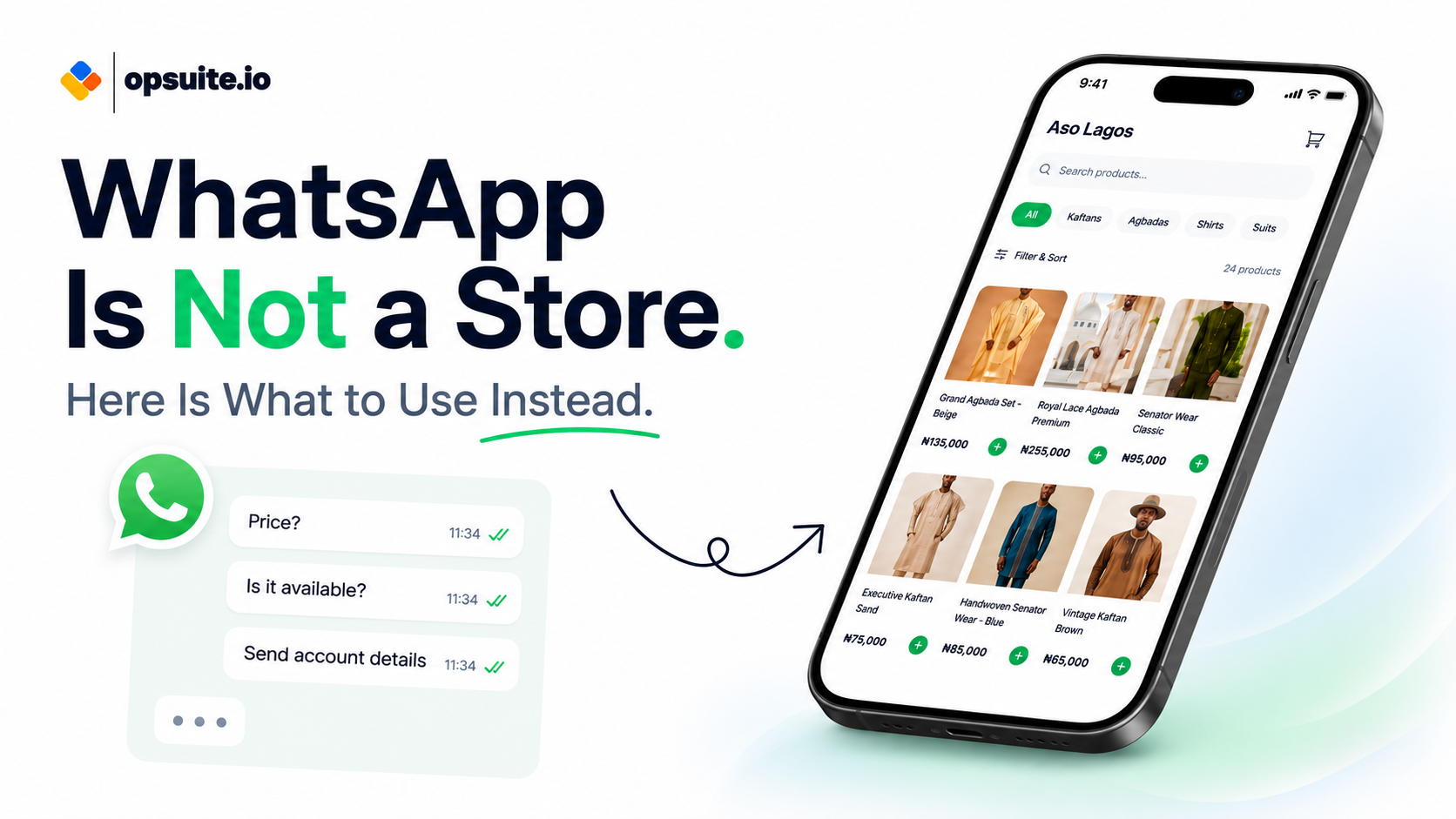
WhatsApp selling works. That is the honest truth and why so many Nigerian businesses rely on it. A customer sees a product on your status or Instagram, sends a DM, you negotiate, they pay to your account, you package and deliver. Simple. Familiar. No upfront cost.
But it only works until it does not. The DM thread gets buried. A payment comes in and you cannot remember which order it is for. A product sells twice because you forgot to update your catalogue status. A customer asks about a previous order and you spend twenty minutes scrolling through chats to find the answer. Your accountant asks for your sales records and you have nothing but a list of transfers with no descriptions.
These are not unusual problems. They are the natural ceiling of selling through a messaging app.
What You Actually Lose
No Inventory Connection
When you sell through WhatsApp, your stock records and your orders live in completely different places. A sale happens in a chat; your inventory spreadsheet does not know. You have to remember to update it. When you forget, which happens, you oversell. A customer pays for something you no longer have. Now you have an upset customer, a refund to process, and a trust problem to repair.
Payments You Cannot Trace
Bank transfers work but they are hard to reconcile. A transfer comes in for ₦18,500 and you have three pending orders around that amount. You guess. Sometimes you guess wrong. And customers who paid properly but were not matched get a bad experience through no fault of their own.
Customer Data That Lives Nowhere
Every customer who buys from you via WhatsApp is a name in a chat thread, not a record in a system. You cannot easily see who your best customers are, how often they buy, or what they usually order. You cannot send them a targeted message next time you restock something they like. The relationship lives only in the app, and it is fragile.
Nothing Goes Into Your Accounts
WhatsApp sales do not appear in any accounting system. At the end of the month, someone has to reconstruct revenue from bank statements and chat histories. It is slow, error-prone, and almost always incomplete. If you are trying to understand whether your business is actually profitable, WhatsApp sales give you no visibility at all.
What Storefront Does Differently
Opsuite Storefront gives your business a proper online shop at its own link. Your products live in a catalogue with images, prices, and variants. Customers browse on their own time, add to cart, and check out. Payment is handled at checkout, confirmed instantly, and the order is recorded.
The moment an order is placed, three things happen automatically. The purchased product is deducted from your inventory. The sale is posted to your accounts as revenue. The customer's details, name, email, phone, and order history, are saved to your CRM.
You still share the link on WhatsApp. You still post on Instagram. But when a customer follows that link, they land in a proper buying experience, not a chat thread. And everything that happens there is recorded, tracked, and connected.
Who This Is Built For
Storefront is not just for fashion brands. It is for any business that takes orders remotely. Bakeries taking pre-orders. Skincare brands with a regular customer base. Food businesses doing meal prep and weekly deliveries. Consultants selling packages or sessions. Gyms offering memberships online. Any business where the transaction currently starts in a DM is a business that Storefront was built for.
Activating It Takes Minutes
Storefront is an add-on to any Opsuite plan that includes POS. You switch it on from your dashboard, set your store headline, choose your accent colour, connect your payment gateway, and toggle which products appear. Your store link is live. Share it wherever your customers already find you.
There is no developer to hire, no hosting to arrange, and no separate platform to manage. The products are already in your inventory. The accounts are already connected. You are not building something new. You are just turning on a channel that was already waiting.